 Uganda is home to many different primate species, with Kibale National Park Containing the highest density in all of Africa. As well as the chimpanzee and gorilla , the black-and white colobus, red-tailed monkey, grey-cheeked mangabey, l’Hooest’s and blue monkeys, and olive baboons can be seen during game drive, launch trips or nature walks, along with smaller nocturnal species such as the bush baby and potto. Mgahinga National Park also contain one of the last remaining habitats of the endangered golden monkey. Black-and-white colobus monkeys are among the most frequently spotted species. The name ‘colobus’’means’’mutilated’’in Greek ,as, unlike other primates, they are lacking thumbs. The troops of 5-10 individuals are easily seen in the branches as a result of their striking coloring-black with long white hair running from the shoulders to rump , and white tuft at the ends of their long tails. Infants are born pure white. The dog-like baboons live in large groups and are regularly seen along roadsides, where they wait to ambush cars in search of food. The spend more time on the group than most other primate species, but sleep in trees at night, these and much more can one enjoy on a chimpanzee safari to Uganda. If water is scarce, they can survive for long periods by linking the dew from their fur.
Tuesday, June 19, 2012
An Exciting Primate Safari in Uganda
Uganda is home to many different primate species, with Kibale National Park Containing the highest density in all of Africa. As well as the chimpanzee and gorilla , the black-and white colobus, red-tailed monkey, grey-cheeked mangabey, l’Hooest’s and blue monkeys, and olive baboons can be seen during game drive, launch trips or nature walks, along with smaller nocturnal species such as the bush baby and potto. Mgahinga National Park also contain one of the last remaining habitats of the endangered golden monkey. Black-and-white colobus monkeys are among the most frequently spotted species. The name ‘colobus’’means’’mutilated’’in Greek ,as, unlike other primates, they are lacking thumbs. The troops of 5-10 individuals are easily seen in the branches as a result of their striking coloring-black with long white hair running from the shoulders to rump , and white tuft at the ends of their long tails. Infants are born pure white. The dog-like baboons live in large groups and are regularly seen along roadsides, where they wait to ambush cars in search of food. The spend more time on the group than most other primate species, but sleep in trees at night, these and much more can one enjoy on a chimpanzee safari to Uganda. If water is scarce, they can survive for long periods by linking the dew from their fur.

Go on A Game Drive And Watch The Lions Strolling Through the Plains
 The lion is one of the most sough-after safari species, and one of the most impressive to observe,L living in prides or around 15 individuals, lion adhere to strict social structures. Groups consist of related females and their cubs, who are often born around the same time and raised communally. New mothers, however, will live in dens with their cubs for the first few days to avoid building up a scent which would attract predators. Anew male taking over a pride will often kill all cubs, and mate with each of the females. The male’s distinctive mane plays a role in making it look much larger and more intimidate to other lions and spotted hyenas-the lion’s main rivals. it is the lionesses, however, who are responsible for around 90% of the hunting, doing so in coordinated groups which can allow them to pursue larger species such as buffalo and giraffes as well as smaller times of antelope. The kill is not shared evenly, however, and only the larger prey is brought back to the pride, making survival difficult for cubs during times of hardship. When on Safari in Uganda , the Queen Elizabeth National park has plenty of Lions and so is the Murchison Falls National park. However the uniqueness of the Queen Elizabeth National park is that is boasts of the Tree climbing lions in the Ishasha sector of the park. So when on a safari the next time look out for this.
Watch The Hippopotamus Sunbathing During your Lauch Cruises
 Hippos are the third largest land mammal after the elephant and the rhinoceros . Weighing in at 1500-1800kg(3300-4000lb),an adult male stands up to 1.5m(4.5feet) at the shoulder, and oddly enough, their closest living relative are whales and dolphins .Hippos spend most of their days submerged in water to keep cool, as they have no sweat glands. Though they have webbed feet, their huge bulk prevents them from floating and they cannot swim. Their size does not, however, prevent them from outrunning human-hippos have been estimated to reach terrifying speeds of up to 30 or even 40km per hour on land. An adult hippo can spend as long as six minutes underwater, and their raised eyes ears and nostrils allow them to remain almost entirely submerged for long periods of time. After spending the day bathing, hippos venture out at dusk and spend the night grazing, traveling up to 8km(5miles) and consuming up to 68kg (150lbs) of Grass each night to maintain their enormous size.
By Martin Isiko
Uganda travel Consultant
Hippos are the third largest land mammal after the elephant and the rhinoceros . Weighing in at 1500-1800kg(3300-4000lb),an adult male stands up to 1.5m(4.5feet) at the shoulder, and oddly enough, their closest living relative are whales and dolphins .Hippos spend most of their days submerged in water to keep cool, as they have no sweat glands. Though they have webbed feet, their huge bulk prevents them from floating and they cannot swim. Their size does not, however, prevent them from outrunning human-hippos have been estimated to reach terrifying speeds of up to 30 or even 40km per hour on land. An adult hippo can spend as long as six minutes underwater, and their raised eyes ears and nostrils allow them to remain almost entirely submerged for long periods of time. After spending the day bathing, hippos venture out at dusk and spend the night grazing, traveling up to 8km(5miles) and consuming up to 68kg (150lbs) of Grass each night to maintain their enormous size.
By Martin Isiko
Uganda travel Consultant
The African Elephant-King of The Big Five
 The largest living land mammal, the African elephant is a sight to behold on Uganda's sprawling savannah. Their massive black forms can be seen from far away marching across the grasslands in search of the incredible amounts of vegetation they need to eat each day, along with around 30to 50 gallons of water. This constant grazing is essential to the ecosystem, as it prevents the savannah and shrub-land from turning into impenetrable forest. The elephant's trunk is by far its most useful feature-it is used with absolute precision to dig, signal, gather food, spray water and dust, siphon water into the elephant's mouth-and even as an extra foot! They are also sociable, affectionate animal, and have been observed caressing companions with their trunks, and greeting other family member when they meet. They will care for weaker individuals, adopt orphaned calves and even display grieving behavior over dead companions. On a Uganda Safari one easily catch the African Elephants in Murchison Falls and Queen Elizabeth National parks.
Uganda-The Number One Birding destination
 Are you a bird lover and you want to experience and see something new then Uganda is the right birding destination for you.located in east Africa, Uganda has taken over the world in terms of bird viewing and the rare types of bird species found in this amazing small country.
Uganda is indeed a birding destination because over half of all bird species in Africa can be found here, making it one of the richest birding destinations on the continent.crammed into this diminutive country is an astonishingly rich diversity of habitats,from the scenic shores of the Albertine Rift and the banks of the mighty Nile River.
The most prized species here is the incredibly rare,prehistoric-looking shoe bill,located among the papyrus swamps. while on a bird tour in Uganda,keep an eye out for the beautiful grey-crowned crane-these elegant birds have wild gold crests and sport the same colors as the ugandan flag(red, yellow and black)-it is the country's national bird.The saddle-billed stork Also displays the flag's colors proudly across its vivid beak.
By Martin Isiko
Are you a bird lover and you want to experience and see something new then Uganda is the right birding destination for you.located in east Africa, Uganda has taken over the world in terms of bird viewing and the rare types of bird species found in this amazing small country.
Uganda is indeed a birding destination because over half of all bird species in Africa can be found here, making it one of the richest birding destinations on the continent.crammed into this diminutive country is an astonishingly rich diversity of habitats,from the scenic shores of the Albertine Rift and the banks of the mighty Nile River.
The most prized species here is the incredibly rare,prehistoric-looking shoe bill,located among the papyrus swamps. while on a bird tour in Uganda,keep an eye out for the beautiful grey-crowned crane-these elegant birds have wild gold crests and sport the same colors as the ugandan flag(red, yellow and black)-it is the country's national bird.The saddle-billed stork Also displays the flag's colors proudly across its vivid beak.
By Martin Isiko
Wednesday, June 13, 2012
Chimp Trekking in Uganda and why Chimps are Special
The Big 5 to look for on a Uganda Safari.
Uganda, One of the World's Best Birding destinations
 Uganda is birder’s paradise. Over half of all bird species in Africa can be found here, making it one of the richest birding destinations on the continent. Crammed into this diminutive country is an astonishingly rich diversity of habitats, from the scenic shores of the Albertine Rift and the banks of the mighty Nile River.
Places of interest for birders to visit while in Uganda include the Mabamba swamps, Kazinga Channel, Bwindi Forest, Samuka Island, Murchison Falls National Park and for sure these areas will make your Uganda Birding Safari memorable.
The most prized species here is the incredibly rare, prehistoric-looking shoebill, located among the papyrus swamps. Keep an eye out the beautiful grey-crowned crane-these elegant birds have wild gold crests and sport the same colors as the Ugandan flag(red, yellow and black)-it is the country's national bird. The saddle-billed stork also displays the flag's colors proudly across its vivid beak.
Uganda is birder’s paradise. Over half of all bird species in Africa can be found here, making it one of the richest birding destinations on the continent. Crammed into this diminutive country is an astonishingly rich diversity of habitats, from the scenic shores of the Albertine Rift and the banks of the mighty Nile River.
Places of interest for birders to visit while in Uganda include the Mabamba swamps, Kazinga Channel, Bwindi Forest, Samuka Island, Murchison Falls National Park and for sure these areas will make your Uganda Birding Safari memorable.
The most prized species here is the incredibly rare, prehistoric-looking shoebill, located among the papyrus swamps. Keep an eye out the beautiful grey-crowned crane-these elegant birds have wild gold crests and sport the same colors as the Ugandan flag(red, yellow and black)-it is the country's national bird. The saddle-billed stork also displays the flag's colors proudly across its vivid beak.
Wildlife to look out for on Safari in Uganda
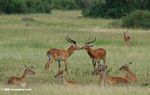 The Antelopes
Uganda is home to an impressive 29 species of antelopes, including the eland- the world's largest antelope, which can measure up to 180cm at shoulder.
Other large species include the greater kudu, which has long, elegant spiral horns and white side stripes; Jackson's hartebeest-an unusual, flat-faced creature found only in Uganda, and the shaggy waterbuck-often found near rivers and lakes, as their names suggests.
Fascinating yet rarely seen is the semi-aquatic sitatunga antelope, whose splayed hooves are adapted for life in the papyrus swamps. Much more common are grant's gazalle, which can live in herd of hundreds of individuals, and pretty Uganda Kob-Uganda's national antelope.
Therefore this more reason to choose Uganda as your safari destination in 2012 and remember that there is lots more wildlife to this as we shall be showing you in other articles and we ensure you enjoy your Uganda Safari.
The Antelopes
Uganda is home to an impressive 29 species of antelopes, including the eland- the world's largest antelope, which can measure up to 180cm at shoulder.
Other large species include the greater kudu, which has long, elegant spiral horns and white side stripes; Jackson's hartebeest-an unusual, flat-faced creature found only in Uganda, and the shaggy waterbuck-often found near rivers and lakes, as their names suggests.
Fascinating yet rarely seen is the semi-aquatic sitatunga antelope, whose splayed hooves are adapted for life in the papyrus swamps. Much more common are grant's gazalle, which can live in herd of hundreds of individuals, and pretty Uganda Kob-Uganda's national antelope.
Therefore this more reason to choose Uganda as your safari destination in 2012 and remember that there is lots more wildlife to this as we shall be showing you in other articles and we ensure you enjoy your Uganda Safari.
Subscribe to:
Posts (Atom)